
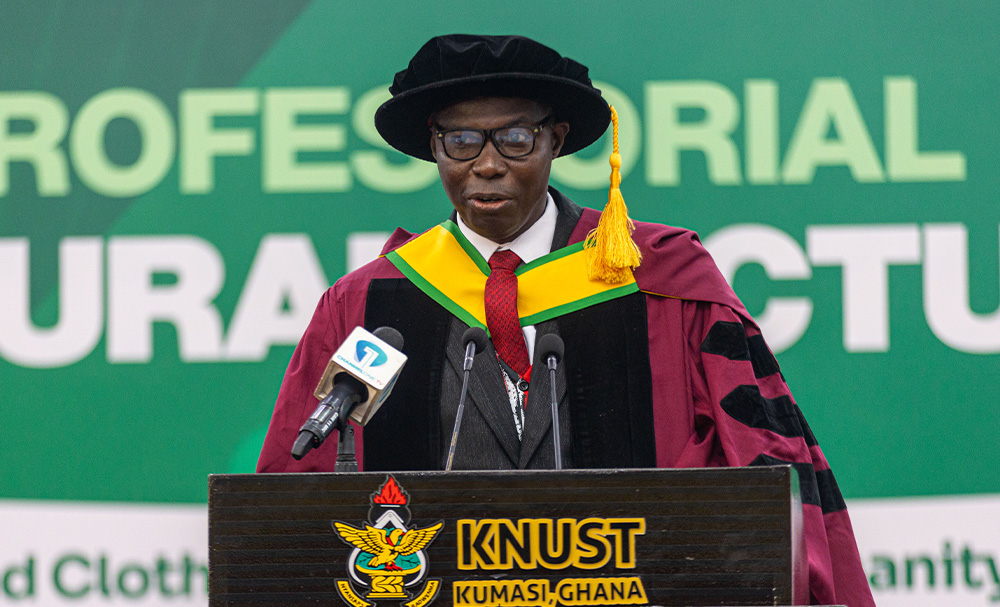
Professor Ebenezer Kofi Howard of the Department of Industrial Art is calling on government to make the textiles and apparel industry the cornerstone of its 24-Hour Economy policy by establishing production hubs in all 16 regions.
He argues that the sector offers one of the country's strongest pathways to industrialisation, job creation and sustainable economic growth.
Delivering his inaugural lecture titled "Beyond Clothing the Nudity of Humanity: How Sustainable Textiles and Apparel Industry Can Rescue Ghana from Its Socio-Economic and Environmental Quagmire," Professor Howard said the industry had the capacity to transform Ghana's economy if backed by deliberate policy interventions.
"I strongly recommend the T&A industry as a pragmatic driver towards the realisation of the 24-Hour Economy Policy," Prof. Howard said.
"I am optimistic that the implementation of my proposed policy framework to establish textiles and apparel firms in all the sixteen regions of Ghana will be a game-changer."
He said the recommendation was grounded in evidence from countries that had successfully used the sector to accelerate industrialisation and employment.
He noted that textiles and apparel manufacturing was particularly suited to round-the-clock production because of its shift-based operations.
"The industry has been tried and tested by giant economies, and even Ghana in the 1960s, and has proven to be the most feasible driver when it comes to the shift system employing three cohorts of workers, thereby creating more employment with an increase in productivity for economic growth," he said.
Prof. Howard argued that despite successive governments introducing initiatives such as import substitution policies, the African Growth and Opportunity Act (AGOA), the National Friday Wear campaign, the One-District-One-Factory programme and a new Textiles and Garments Manufacturing Policy currently under review, Ghana's textile industry continued to decline while the country became increasingly dependent on imports.
He said Ghana imports more than 70% of its textiles and garments while exporting less than 10%, leaving fewer than 2,000 employees across the country's four surviving large-scale textile companies.
The apparel industry employs more than 6,000 workers but relies heavily on imported raw materials and equipment.
"Ghana is sitting on gold but begging for straw," he said.
He attributed the industry's decline to decades of trade liberalisation, obsolete machinery, limited domestic raw materials, smuggling and an influx of imported textiles and second-hand clothing, which have undermined local manufacturers.
According to Howard, the global textiles and apparel industry is worth more than US$5 trillion and employs over 300 million people, making it one of the world's largest industrial employers.
"It creates strong backward and forward linkages with agriculture, manufacturing, transport, engineering, finance and services," he said, adding that Ghana had failed to take full advantage of the sector's economic potential.
Drawing on more than two decades of research, Howard said the country's textile value chain had weakened to the point where most garments worn in Ghana relied on imported fibres, yarns, fabrics, dyes, machinery and production inputs.
"There is no doubt that 'Ghana is Economically Naked'," he said, arguing that the country had surrendered a significant share of the textiles value chain to foreign producers.
He also criticised Ghana's dependence on second-hand clothing imports, saying the trade had become both an economic and environmental burden.
"Ghana has become a dumping site for second-hand clothing," he said.
"The environmental concerns of second-hand clothes cannot be overemphasised. Our streets, water bodies and drainage systems display discarded second-hand clothes."
Howard described second-hand clothing imports as a "cankerworm" silently weakening domestic textiles and apparel production while contributing to waste management challenges.
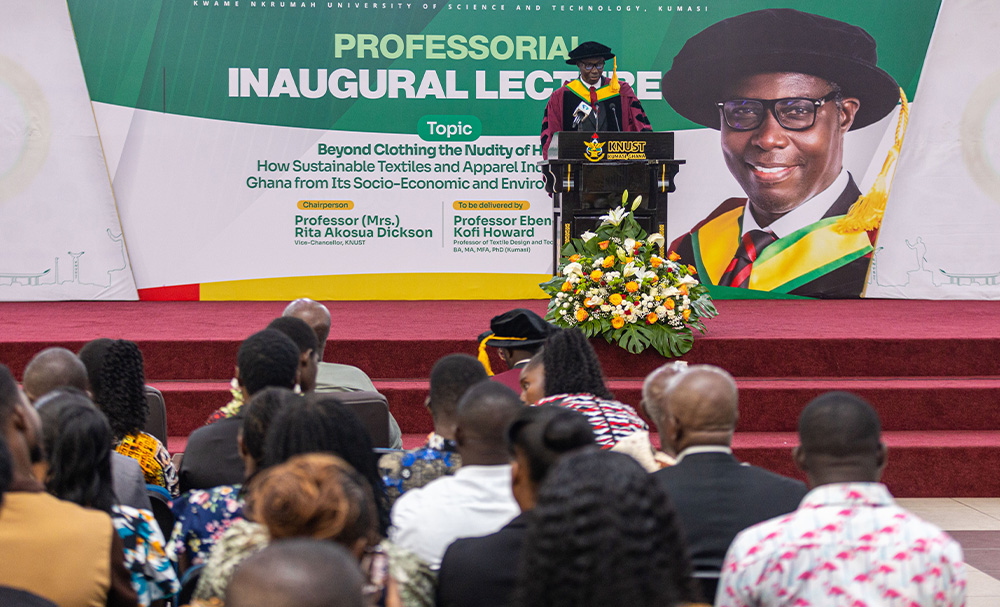
Beyond the 24-Hour Economy proposal, he called for the implementation of a comprehensive national textiles and apparel production policy anchored on meritocracy, pragmatism and honesty rather than political considerations.
He urged the government to revise the draft national policy to broaden raw material development beyond cotton, strengthen the role of Ghanaian experts and institutions, and accelerate implementation.
Prof. Howard also advocated restructuring the Cotton Development Authority to regulate and promote cotton production while investing in sustainable natural and synthetic fibre production to support domestic manufacturers.
He said his research team had developed several sustainability models for the cotton, textile and apparel sectors, including frameworks to improve productivity, environmental performance, regulatory compliance and competitiveness, all aimed at supporting Ghana's industrial transformation agenda.
The professor pointed to countries including Bangladesh, Vietnam, India, China, Cambodia and Sri Lanka as examples of economies that had successfully leveraged the textiles and apparel industry to create jobs and drive economic growth.
"If these countries have successfully used the T&A sector to transform their economies and created jobs to improve the livelihood of their citizens, then I am optimistic that Ghana can do better with good leadership and favourable policies," he said.
Prof. Howard concluded that revitalising the textiles and apparel industry would not only reduce unemployment and import dependence but also preserve Ghana's cultural heritage, improve environmental sustainability and strengthen national economic resilience.
"The T&A sector holds the answer," he said.


